The strike makes the tone
The same phrase on the same calculated bars, only the mallet changes: felt, wood, metal, rubber, finger. The difference comes from the hardness of the tip and the time it stays on the bar, not from recordings.
Framework SoundInstrumentsPhysics
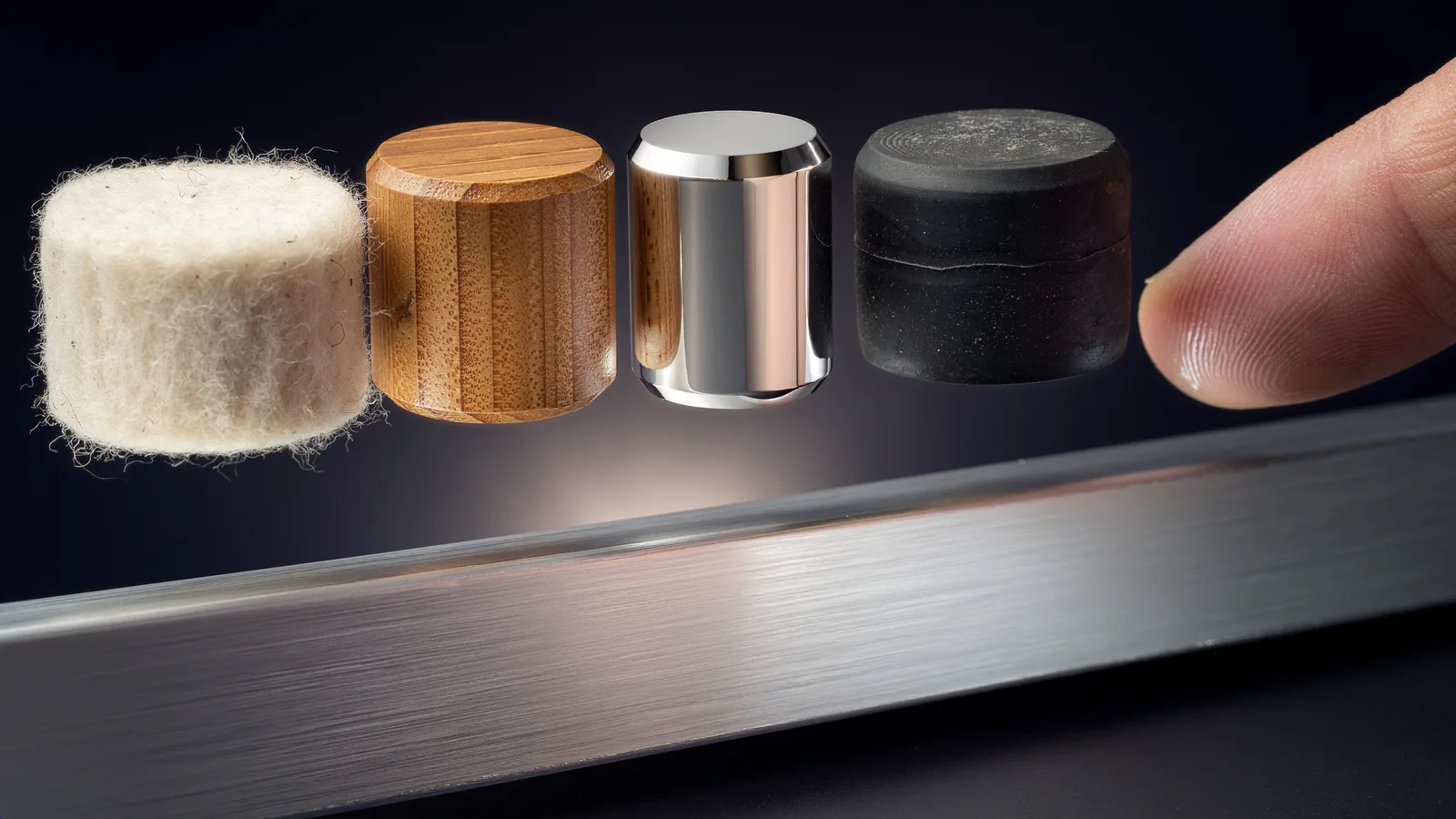
With a felt mallet the same bar sounds soft, with metal bright and hard. In PSOrvia that does not come from recordings but from calculation: the mallet hits the calculated bar with a Hertz contact. The stiffer the tip, the shorter the contact, the more high partials it excites. The hardness of the mallet is its modulus of elasticity: finger 0.02 GPa, rubber 0.05 GPa, felt 0.31 GPa, wood 10 GPa, metal 200 GPa.
The five listening examples play the same phrase, composed for this page, about eleven seconds long. For each note the aluminium bar is cut so that it hits exactly that pitch, and all bars of a note have the same mass. Strike point, strike speed per note and small room are the same; with the mallet, hardness, rebound, mass and tip radius change as they belong to felt, wood, metal, rubber and finger. All examples carry the same gain, none is matched afterwards: what sounds louder really is louder.
Contact time after Hertz, calculated for the note A4: metal 0.08 ms, wood 0.19 ms, felt 1.02 ms, rubber 2.38 ms, finger 3.52 ms. Measured on the sound: the share of the energy above 3 kHz is 4.1 % for metal, 2.1 % for wood, and below 0.1 % for felt, rubber and finger. The longer the contact, the fewer highs get through.
The sixth file plays the mallets one after the other, four notes each.
Listen
All mallets one after the other
The same phrase: Felt
The same phrase: Wood
The same phrase: Metal
The same phrase: Rubber
The same phrase: Finger
Keyboard: Space plays or pauses, arrow keys jump 5 seconds, Home and End go to start and end.