The bow makes the tone
The same melody on the same calculated string, only the way of playing changes: bow near the bridge or over the fingerboard, light or firm pressure, fast stroke. The difference comes from sticking and slipping, not from recordings.
Framework SoundInstrumentsPhysics
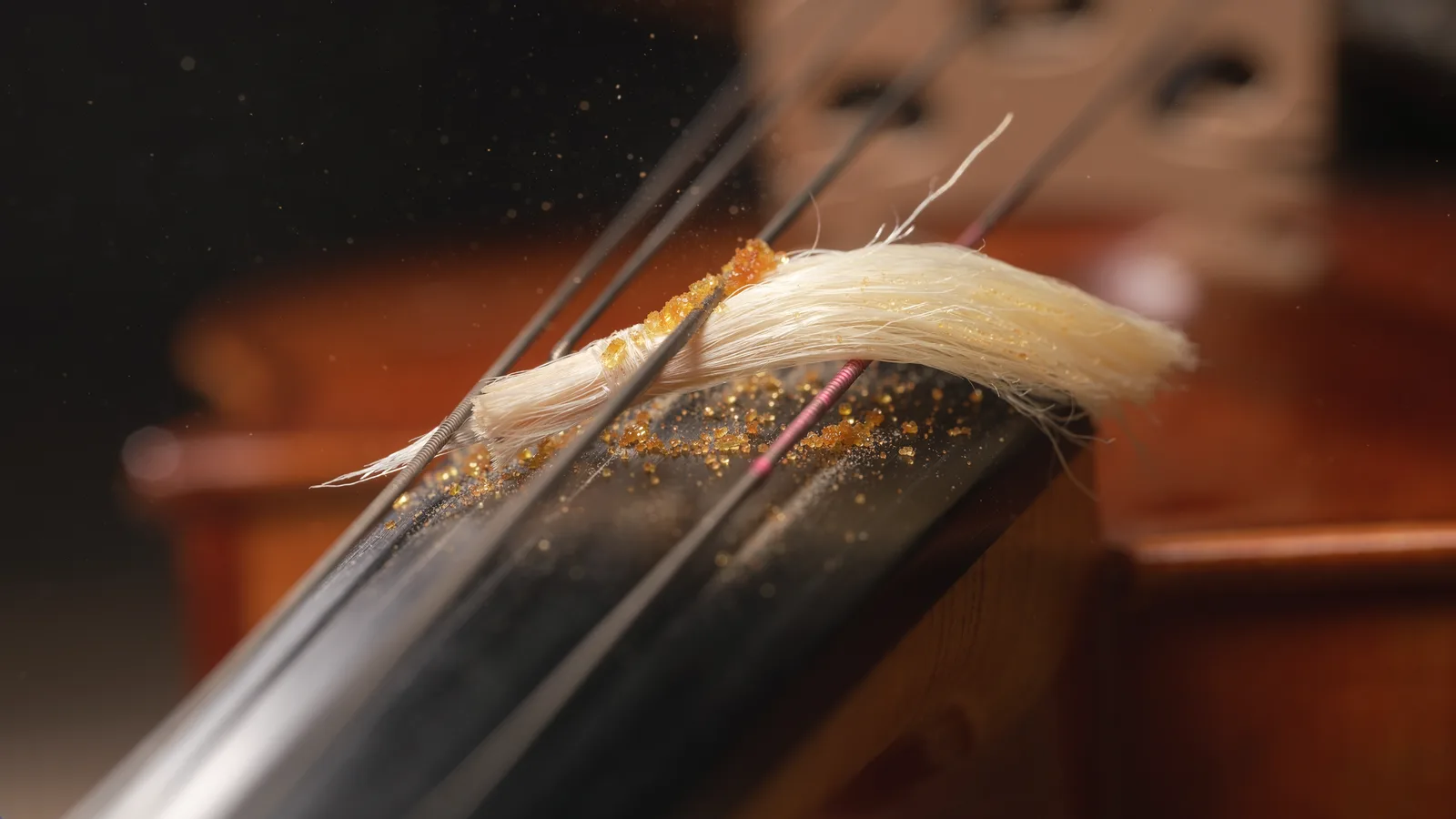
A bow turns steady pressure into a tone. In PSOrvia that is a calculation, not a recording: the bow hair sticks to the string until the string's restoring force is stronger, slips, and sticks again. How this sticking and slipping unfolds depends on where the bow sits, how firmly it presses and how fast it moves.
The six listening examples play the same phrase, composed for this page, a good twelve seconds long, on a string with a fundamental of 196 Hz; body and small room are the same. The basic way of playing puts the bow at 13 % of the string length from the bridge. Every other example changes exactly one quantity: close to the bridge (4 %), over the fingerboard (32 %), light pressure, firm pressure, fast stroke. All examples carry the same gain, none is matched afterwards: what sounds louder really is louder.
Measured is the spectral centroid of the phrase, without room: basic playing 1.4 kHz, near the bridge 1.3 kHz, over the fingerboard 1.1 kHz, light pressure 0.5 kHz, firm pressure 1.6 kHz, fast stroke 1.2 kHz. Light pressure sounds dark and soft, firm pressure brighter and rougher. In the model the bow speed mostly changes the loudness, hardly the timbre: the fast stroke is therefore mainly an example with more level.
The seventh file plays the ways of playing one after the other, four notes each.
Listen
All ways of playing one after the other
Basic playing
Bow near the bridge
Bow over the fingerboard
Light pressure
Firm pressure
Fast stroke
Keyboard: Space plays or pauses, arrow keys jump 5 seconds, Home and End go to start and end.