From a little bell to a church bell
The same strikes on the same calculated bell, only the diameter grows: from a thimble to a tower bell. Pitch, ring time and the number of partials follow from the size.
Framework SoundInstrumentsPhysics
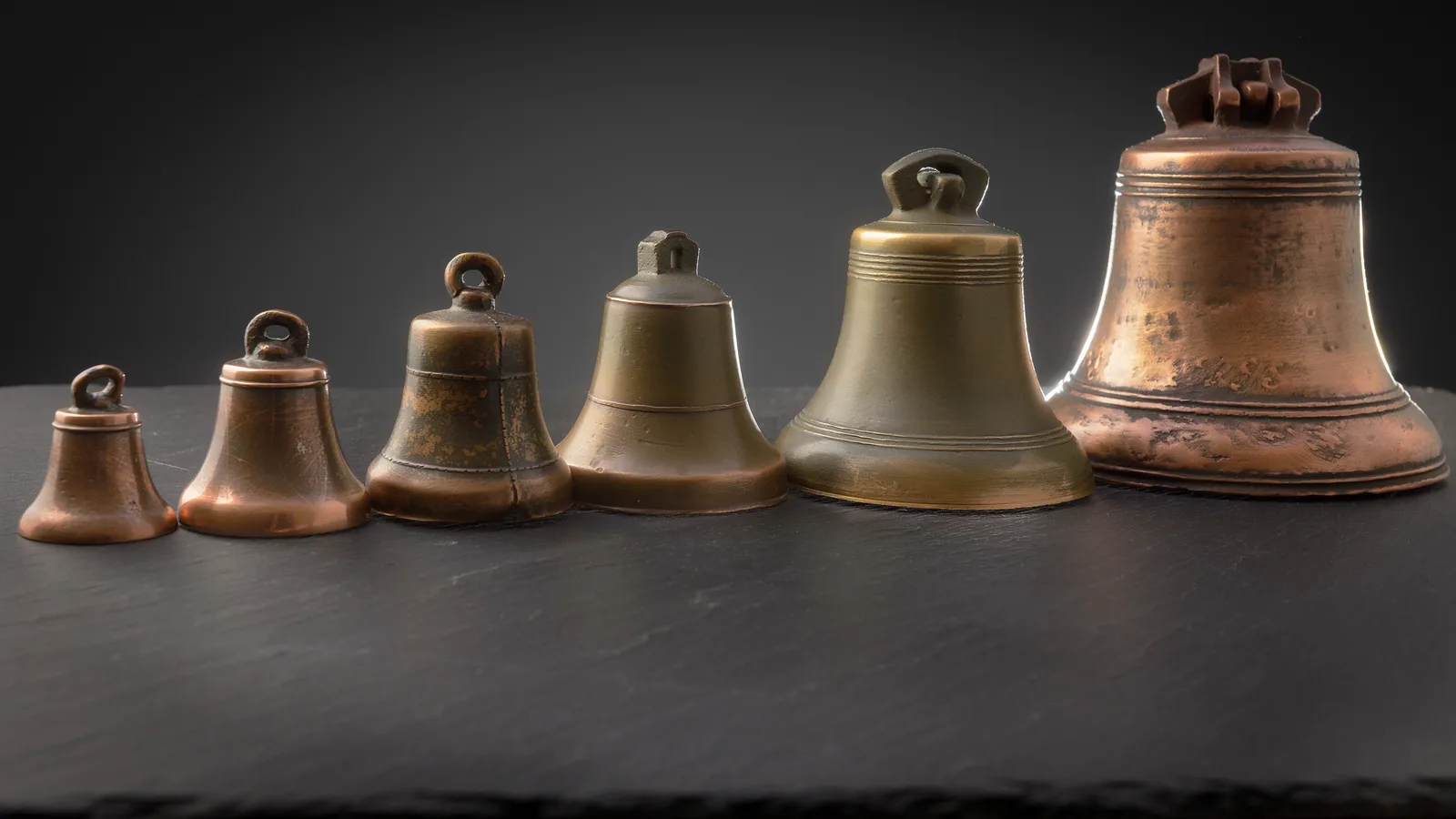
The bigger the bell, the lower and longer it sounds. In PSOrvia that does not come from recordings but from calculation: a bell here is a calculated shell of bell bronze. Its vibrations, their pitches and how they die away follow from diameter, wall thickness and material. The wall thickness is always one fifteenth of the diameter, the clapper grows with the bell, material, strike speed and small room are the same.
The six listening examples play the same sequence of four strikes, composed for this page, with diameters of 2 cm, 6 cm, 15 cm, 40 cm, 1 m and 2.2 m. All examples carry the same gain, none is matched afterwards. Only the level of the calculation grows with the square root of the diameter, by the same law for every size; otherwise the tower bell would hardly be audible next to the thimble.
Fundamental of the lowest vibration: thimble 5.5 kHz, little bell 1.8 kHz, hand bell 738 Hz, cow bell 277 Hz, church bell 110 Hz, tower bell 50 Hz. Ring time of the strongest vibration (a drop of 60 dB, extrapolated from the decay down to 25 dB): 0.2 s, 0.9 s, 0.8 s, 2.1 s, 5.3 s and 12.5 s. The number of partials below 16 kHz grows from 2 through 3, 6, 11 and 18 to 28. The material values come from published tables; the loss factors are estimates.
The seventh file plays one strike of each size one after the other.
Listen
All sizes one after the other
Thimble, 2 cm
Little bell, 6 cm
Hand bell, 15 cm
Cow bell, 40 cm
Church bell, 1 m
Tower bell, 2.2 m
Keyboard: Space plays or pauses, arrow keys jump 5 seconds, Home and End go to start and end.